Friday, July 26, 2013

Tossing Tables at the Temple


This section of five verses in MARK seems rather straight-forward; yet, to glean what was written by the author and assist in moving ahead, it's helpful to have a visual lay of the land.

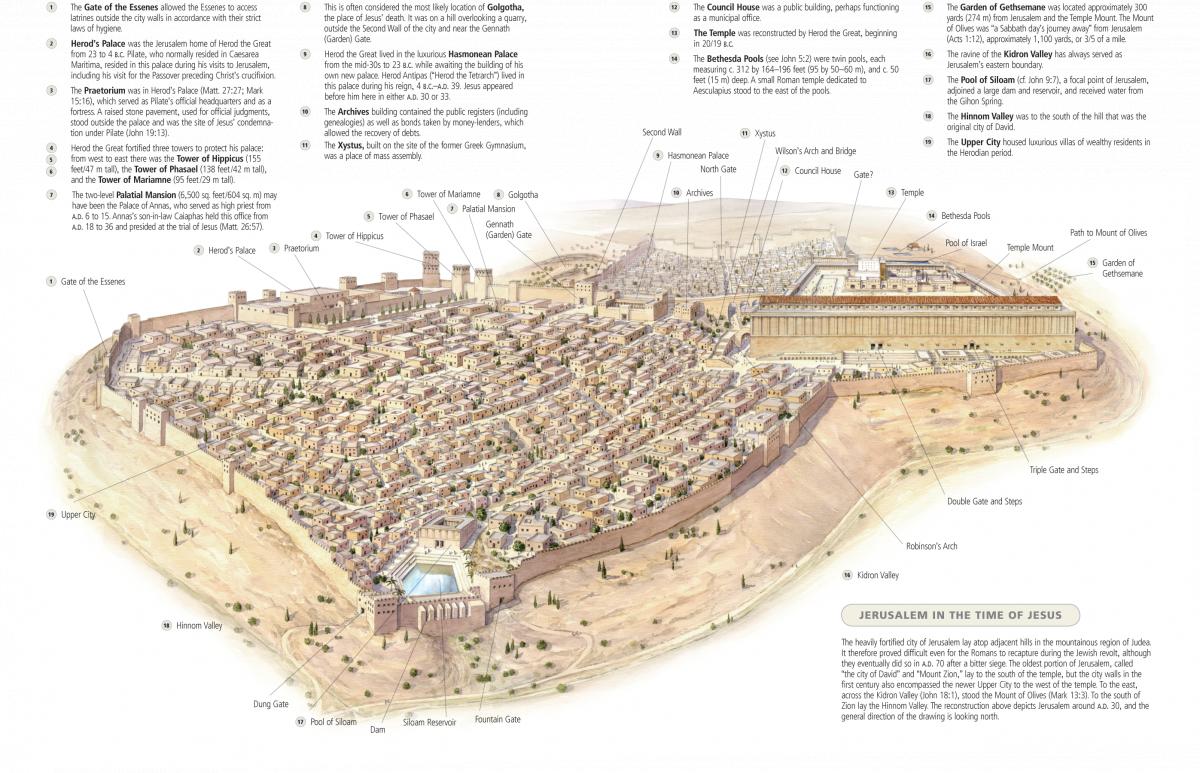
First, a link that depicts Jerusalem around 30 AD; the general direction of the drawing is north -- Jerusalem in the Time of Jesus. To the upper right of the drawing is the area from which Jesus and his disciples traveled -- "Path to Mount of Olives" and "Garden of Gethsemane" -- to get to the Temple.

Second, a link that depicts the Temple Mount. To the right is the eastern wall of Jerusalem -- again the direction from which Jesus and his disciples came.

Before entering the temple precincts, pilgrims would bathe themselves (a cleansing ritual) -- lower left on the drawing. Within this formidable structure, approximately 30 acres large [i], was the Temple Mount, which was separated by walls and gates -- a square within a square within a square.

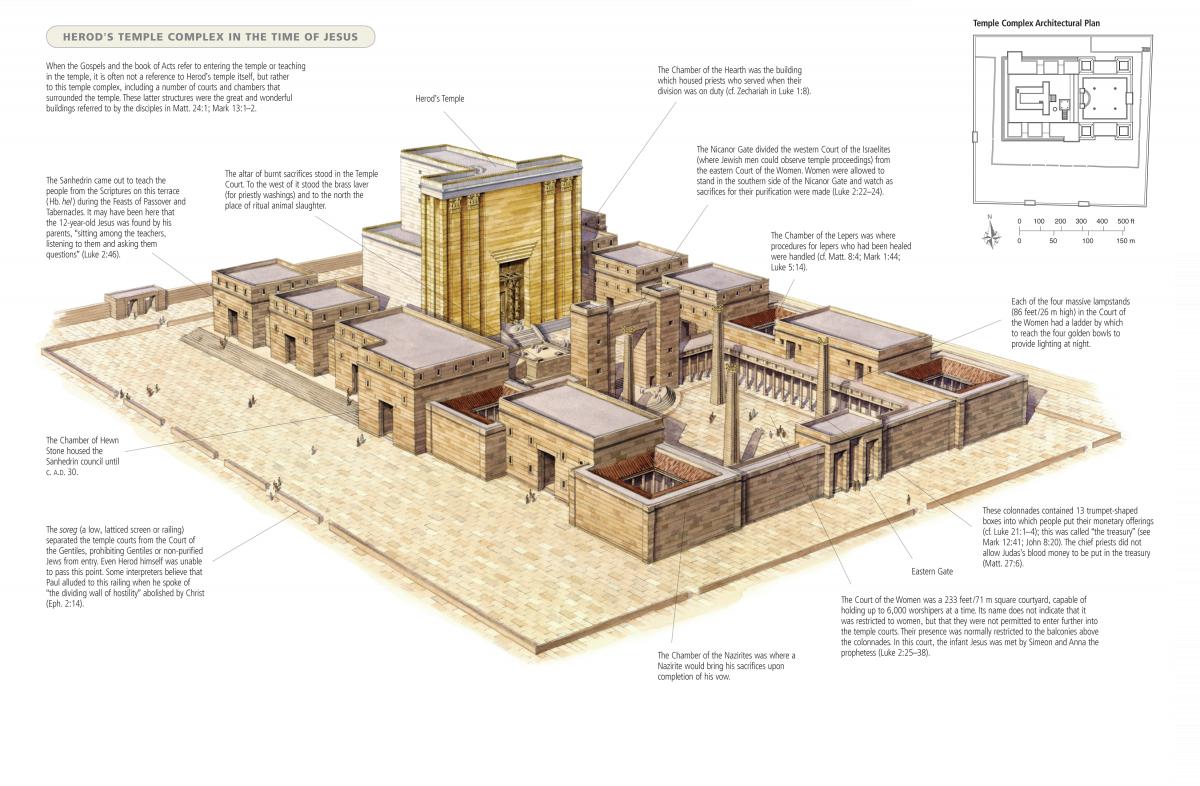
Third, a link that depicts the Temple Complex in the time of Jesus.

A soreg (a low, latticed railing about four feet high with large openings guarded by Levites [ii]) surrounded the temple complex, separating Gentiles and non-purified Jews from entering the temple courts and chambers. It was said if a Gentile passed this particular point, the Court of the Gentiles, the penalty was death. [iii]

Throughout the complex, various chambers and courts were designated. Women may enter past the Court of the Gentiles; however, unless they had a sacrifice to offer, they may not proceed further than the Court of the Women. In the Court of the Israelities, offerings were handed by the worshippers to the priests. [iv] The inner court was the Court of the Priests. Within the Court of the Priests was the Temple.

The approximate size of the temple complex would be the length and width of two football fields. The whole area, with all of the different Courts, was the sacred precincts (hieron). [v]

Fourth, a link that depicts Herod's Temple (otherwise known as the Second Temple which replaced the First Temple destroyed when the Jewish nation was exiled to Babylon). The Temple (later destroyed in 70 AD) was located on the site now known as the Dome of the Rock.

Let's next focus on…

Money changing hands -- "…selling and those who were buying in the temple." To get a clearer picture, what exactly was being exchanged and at what cost to the individual buying?

Did You Know…?
Only one coin was accepted as proper payment for the Jewish Temple tax -- the Tyrian shekel. Every Israelite male over 20 years old was required to make an annual payment of a half-shekel (Exodus 30:13-16, 38:26). In everyday business, the Jews used Roman coins which contained 80% silver. The religious authorities demanded only Tyrian shekels (95% purity) be used to pay the Temple tax. [vi]

To put this into perspective, consider a half-shekel as a sum of 6p. "This was the equivalent to one or two days' wages for an average worker." [vii]

Adding to this, using instructions provided in Exodus chapter 12, the Jews were to choose a lamb for the Passover sacrifice. Only an unblemished lamb would suffice, and it would be thoroughly checked. But what if you couldn't afford a lamb? Leviticus 5:7 allowed the poor to offer two doves as a substitute sacrifice.

Outside, doves could be bought cheaply for 3.5p a pair, but they also had to be without blemish. You can imagine the "gain" game with the temple inspectors. Because inside, the cost for a pair of doves would be as high as 75p. [viii] At that price, the low end to afford this would be 12 days worth of wages.

Plus… there was a fee for the exchange service "as high as 10 or 12 percent." [ix] Should the coin brought for exchange exceed the tax of a half-shekel, there would be another fee before the person could actually get their change. [x] Talk about a crooked shell game. As Leah * stated, "It was a shake-down!"

A half-shekel here, possibly 12 half-shekels there, a few more half-shekels for this and that,… Throw in the time it took travelers to get to the Temple and back home, plus the number of days in Jerusalem. It all adds up to a lot of lost wages.

It didn't stop there with the coins. "The sellers either belonged to the High-Priestly hierarchy or paid a large fee to temple authorities for the privilege of selling. Whichever was the case, the High-Priest's family benefited monetarily." [xi]

Who wasn't benefiting from this mind-boggling, sleight-of-hand scenario? Those honestly wanting to honor God.

In verse 15, Jesus entered the temple area which would've been the Court of the Gentiles. It was the largest section of the Temple complex and open to anyone -- not just Gentiles. With the inner Temple precincts being relatively small, most Jewish worshipers probably ended up in this outer court. While Gentiles couldn't go past this area, those Jews who were ritually pure could proceed across the balustrade to the next level. [xii]

This outer court was meant for prayer and preparation however it had to have been utter chaos with pilgrims, merchants, money changers, authorities, animals filling this space. With thousands of people in Jerusalem for Passover, with thousands of animals being brought and bought in the court, visualize the loud, crazed trading floor atmosphere of the Wall Street Stock Exchange mixed together with a cramped, smelly Livestock Auction. How could one quietly reflect or even think clearly enough to formulate a prayer?

And the court was also being used as a shortcut by people carrying pots, pans and various containers, which was actually considered a sacrilege by the Rabbis. [xiii] This refers to verse 16.

Where was the reverence for God?!? No wonder Jesus was angry! 

In verse 17, Jesus makes mention of Isaiah 56:7. "For all nations" are gathered together in this part of the temple, but worshipful prayer has been replaced by greed and those openly robbing the poor.

Jesus was defiantly challenging the sacrificial system. Jesus was defiantly challenging the religious system so that "all nations" have direct access to God. He was taking head-on the scribes and the chief priests.

The people were astonished and mesmerized, spellbound and in awe. A revolution was taking place, and fear had struck the hearts of the authorities who stood to lose everything.

This Jesus had to be stopped!

NEXT
On whose authority?; facing the truth


[i] The Gospel of Mark, Barclay -- p. 272
[ii] Daily Minyan, "Court of the Gentiles in the Jewish Temple," Gene Schlomovich
[iii] The Gospel of Mark, Barclay -- p. 272
[iv] The Gospel of Mark, Barclay -- p. 273
[v] The Gospel of Mark, Barclay -- p. 273
[vi] The Role of Coins in the First Revolt -- USC
[vii] Jewish New Testament Commentary -- p. 56
[viii] The Gospel of Mark, Barclay -- pp. 273-274
[ix] MacArthur Study Bible -- p. 1486
[x] The Gospel of Mark, Barclay -- p. 273
[xi] MacArthur Study Bible -- p. 1485
[xii] Daily Minyan, "Court of the Gentiles in the Jewish Temple," Gene Schlomovich
[xiii] The Renaissance New Testament -- p. 305

* Member of the Study Group

Thursday, July 18, 2013

For the Love of Figs!


As with stories, the well-known one about the fig tree has been told throughout the centuries. Well,… it can be confusing as to "which" fig story is the one we know. And... is it actually true?

First, the facts about fig trees.

Did You Know…?
From the time fig trees are planted, it will be three years before they bear fruit (usually in late spring [June] and in the early autumn). [i] Also, these types of trees produce fruit before they produce leaves. [ii]

If we go with the gospel story as written by Mark -- know as "Jesus Curses the Fig Tree" -- verse 13 reveals a fig tree which had produced leaves before fruit. In fact, Jesus spotted this particular tree from a distance and then approached. It had the promise of fruit -- of which there was none.

What we've studied and heard about Jesus, does it fit his "being" to utter a curse -- no less curse a fig tree?

Consider the following:
* Luke 13:6-9 -- a parable about a fruitless fig tree. This may be the story that you remember instead of the one in MARK.
* LUKE doesn't even mention this incident -- of Jesus cursing a fig tree.

Was Jesus making a point by means of prophetic drama? Using "acted out" examples from the Old Testament,… Jeremiah bought and then broke a clay bottle (Jeremiah 19); Ezekiel made and then burned up a model of Jerusalem (Ezekiel, Chapters 4 and 5). A New Testament example of this is Acts 21:10-11.

Another "fig story" from memory might be the one from Matthew 7:16-20. While a brief mention of figs is made, the bearing of fruit is significant. How so? Because "you will know them by their fruits." It is an expectation. It is an active faith. Which also ties into John 15:1-8 in the removal of every branch that bears no fruit. For what does inactivity bear?

Other examples of unfruitful trees -- Isaiah 5:1-7, Jeremiah 8:13 and Micah 7:1 -- symbolize an unfaithful people. 

It wasn't the season for figs. The Jewish religious authorities of Israel are unwilling to receive Jesus and his Good News.

Yet, "May no one ever eat fruit from you again," comes across extremely harsh. Is it a curse? Or… is it a statement of hope? An expressed hope that no one should be oppressed by the religious authorities and put at a distance from God. Take away the sting, remove the supposed "curse" (for which, by the way, there is no exclamation mark), and it has different meaning.

Now for "The Lesson from the Withered Fig Tree."

The next morning as Jesus and the disciples passed by the fig tree they noticed something drastically different. The barren tree had withered away down to its roots. You know there had to be an exchange of some "oh, no, he didn't" looks among the disciples. Peter states the obvious, "The fig tree that you cursed has withered."

Emphasis seems to be on the curse, and I've underlined these words to make it standout. Nevertheless, if this is what Jesus truly wanted to emphasize, as in "You're right, and nobody better mess with me because they'll get some more of that nasty mojo," why would he reply as written? Why would he start off with, "Have faith in God"?

Because a teacher never stops teaching!

The symbolism of the "roots" of the withered fig tree had a correlation. In verse 23, "this expression was related to a common metaphor of that day, 'rooter up of mountains,' which was used in Jewish literature of great rabbis and spiritual leaders who could solve difficult problems and seemingly do the impossible." [iii] Another way to put it, he would be "called a mountain-remover." [iv]

Question for Thought
Is the mountain, to which Jesus refers, the Temple? …The religious leaders of Israel?

When reflecting on these last three verses, your eyes may be drawn to "prayer." Certainly, as mentioned in previous blog posts, prayer is imperative. One may find prayer though to be challenging. As you know, I'm particularly fond of the insights of William Barclay, who was a world-renowned Scottish New Testament interpreter. This profound scholar felt there were three [abbreviated] rules for prayer:

1) It must be the prayer of faith. Whatever problems and difficulties we may have, take them to God. In so doing, we need to be ready to accept God's guidance when given.
2) It must be the prayer of expectation. Don't pray by rote or making it a mere formality. It must be of hope. As Barclay states, "It should be a thing of burning expectation."
3) It must be the prayer of charity. The principle of God is love, for he is love. [v]

You may be drawn back to what led into the three verses -- Have faith in God. "More important than religious institution and practice is faith in God, which can accomplish the seemingly impossible (Mark 10:27). Such faith is required in order to forgive anyone against whom you have anything." [vi]

What do we get out of these two sections of verses when put together? Does it matter if it actually happened as written?

The fig tree isn't doing its job -- the job for which it was created -- to produce fruit. The tree becomes a metaphor for Israel. All come into question. To have true faith in God, do we bear fruit? How do we live out our faith? And where Jesus is headed -- to the Temple -- what kind of fruit is being produced there? What kind of prayer is being given?

I conclude this post with a tidbit which leads into next week's focus -- Jesus and the Temple. There's a phrase in Texas to which I'll take some liberty. "It wasn't Jesus' first time to the rodeo."

Although it is the only time mentioned in MARK that Jesus has traveled to Jerusalem, there is record of other visits: John 5:1, 7:10. Three years earlier, Jesus had also cleansed the Temple: John 2:13-16.

Now why in the world am I bringing this up? Because I found all of this quite intriguing.

* How long does it take a fig tree to bear fruit? From planting the seed to fruit producing, three years.
* When did Jesus last "cleanse" the temple? Three years prior. He had planted the seed of the fig tree -- of the "Good News" -- then and there in this place.
* In verse 11 (just before all of this: 12-14, 20-25), Jesus has gone to the temple and seen exactly what that "fig tree" has produced -- three years later. No fruit.
* It will take a "mountain-remover" (Jesus) to remove the Jewish authorities (the mountain) from power and control. To the 99%, it seems impossible. Jesus states and believes otherwise.

It was not the season for figs.
May no one ever eat fruit from you again.
Have faith in God.
If you say to this mountain,… it will be done for you. .

What will happen once the "mountain" has been removed?

NEXT
Time for the tables to be turned

[i] Living Application Bible, NIV -- p. 1759
[ii] The Renaissance New Testament -- p. 302
[iii] MacArthur Study Bible -- p. 1486
[iv] The Gospel of Mark, Barclay -- p. 276
[v] The Gospel of Mark, Barclay -- pp. 276-277
[vi] HarperCollins Bible Commentary -- p. 915

Thursday, July 11, 2013

Enter The King


Logistically, Jesus and the disciples draw near to their destination. To give you an idea of the travel distance remaining,…

The town of Bethany -- "house of dates" -- on the eastern slope of the Mount of Olives, was two miles east of Jerusalem. [i] It was where the sisters and brother, Mary, Martha and Lazarus, resided. As told in Scripture, the three siblings were loved equally by Jesus.

Also east of Jerusalem, near Bethany, was the small town of Bethphage -- "house of unripe figs." It was on the southeastern slope of the Mount of Olives. [ii]

And the mountain that stood between the two towns (Bethany and Bethphage) and the city of Jerusalem was the Mount of Olives -- associated with the arrival of the Messiah (Zechariah 14:4). Directly opposite from the Temple, this hill was across the Kidron Valley to the east.

To give you a visual of the area, here's a link to an overhead map.

The Passover festival was about to begin. Just what exactly is "Passover"? Let me lead the way for explanation in briefly describing three major festivals (Pesach, Shavu'ot and Sukkot) with historical significance.
* Pesach, known as Passover, begins on the 15th day of the Jewish month of Nissan. It is the first of three major festivals. [iii] Jews from various parts of the world were traveling to observe this holiday -- when the people of Israel were freed from their enslavement to Pharoah. Exodus, Chapters 1-15 tells the story.
(More to share about Pesach as we move further into Chapter 11.)
* "Shavu'ot commemorates the anniversary of the day God gave the Torah to the entire nation of Israel assembled at Mount Sinai. …They became a nation committed to serving God. The festival of Shavu'ot marks the completion of the seven-week counting period between Passover and Shavu'ot." [iv]
* You may remember from a previous post, The Transformer, Sukkot means "booths" -- the temporary dwellings (incorporating palm leaves) in which the children of Israel lived while wandering in the desert for 40 years. Sukkot, which lasts for seven days, is commonly referred to in Jewish prayer and literature as the "Season of our Rejoicing." [v]

So with this overview, let's delve into these 11 verses…

"A colt that has never been ridden." Is that the way a true King should enter Jerusalem? On a donkey?!? We have two contrasts -- one from Zechariah 9:9 which focuses on humility (yet triumphant and victorious); the other from Psalms of Solomon 17 -- more so verses 21-45, which is more militant. The military leader of conquering armies would definitely ride on a horse.

While Zechariah 9:9 was a prophetic vision, there was precedent that "the coronation of a king in Israel also included the colt (Genesis 49:11)." [vi]

When reflecting on Jesus' triumphal entry into Jerusalem, I recalled the second half of verse 8 but had completely forgotten the first half. "Many people spread their cloaks on the road,…"

Did You Know…?
To welcome an anointed king, garments were thrown on the ground. 2 Kings 9:13 gives an example. "Then hurriedly they all took their cloaks and spread them for him on the bare steps; and they blew the trumpet, and proclaimed, 'Jehu is king.'" [vii] The Jehu to which this refers rose in power as one of the bloodiest kings in Israel's history.
For more on the fascinating story of Jehu, read 2 Kings, Chapters 9, 10.

As for the second half of verse 8, "leafy branches" has traditionally come across as palm fronds (a tie-in to Palm Sunday). But the word used for leafy branches "means anything that grows in a field suitable for a soft bed or pathway." [viii] So the wild vegetation spread on the road wasn't necessarily palm leaves.

Then the people, who acclaim Jesus, shout, "Hosanna!" At the top of their lungs comes praise and adulation. Right?

"Hosanna!"

The Greek ôsanna transliterates the Hebrew hoshia' na, which literally means… "Save, please!" [ix] What?!? The people were shouting to Jesus riding by on a donkey colt,…

"Save, please!" "Deliver us, please!"

While praise and adulation may play a part in "Hosanna," much more is going on behind this powerful word coming from the lips of so many in need.

Furthermore, "Blessed is the one who comes in the name…" was a recognition by the crowd of the messiahship of Jesus. "…Of the Lord" was with the power and authority "of Adonai!" [x] They're referring to / quoting Psalm 118:25-26, which "is sung at the pilgrimage festivals of Passover, Shavu'ot and Sukkot." [xi]

These people wanted their Messiah -- "our ancestor David" also "Son of David" -- to deliver them from Roman oppression. Verse 10 though wasn't a direct quote. It was added to make the connection with the coming Davidic kingdom. [xii] Only in the Gospel of Mark is this tribute recorded.

Nonetheless…

The emotions are high! The revolution and overthrow is about to begin! "Blessed is the Messiah! You're going to exercise God's power and authority on earth! You're going to deliver us! You're going to save us!"

Oh, but how the tide will turn regarding these fever-pitched people in just a matter of days.

NEXT
Jesus curses?!?; have faith in [who, what]?; and to forgive


[i] MacArthur Study Bible -- p. 1484
[ii] MacArthur Study Bible -- pp. 1431, 1484
[iii]  www.jewfaq.org-- Pesach
[iv] Wikipedia -- Shavu'ot
[v] www.jewfaq.org -- Sukkot
[vi] Jewish Annotated New Testament -- p. 83
[vii] 2 Kings 9:13 (NRSV)
[viii] The Renaissance New Testament -- p. 274
[ix] Jewish Annotated New Testament -- p. 63
[x] Jewish Annotated New Testament -- p. 63
[xi] Jewish Annotated New Testament -- p. 83
[xii] Jewish Annotated New Testament -- p. 83