Friday, August 9, 2013

Was, Is and Will Be


Scripture states Jesus spoke to the gathered crowd at the temple in "parables." A parable, as we know, was meant to be heard, and its meanings sparked within each person in various ways. What sparked within you didn't necessarily spark within me.

Through the use of an allegory, spiritual meaning may be symbolized in the use of events or characters. It's used to illustrate a truth.

So what do we have here? A parable? An allegory?

While not all of the details here have inner meaning, there are definitely some which do. As we move forward, one could say this is a hybrid between a parable and an allegory.

Jesus wisely begins by using a descriptive setting to which the people can relate -- a vineyard. "The hillsides of Palestine were covered with grape vineyards, the backbone of the economy." [i]

By use of the vineyard, other elements were understood:
* The need for a fence to be in place -- to keep out unwanted animals like wild boars as well as potential robbers;
* A pit (wine vat) beneath the wine press -- the juice from the squeezed grapes would be collected in this basin;
* A watchtower -- to keep watch over the vineyard, for shelter, and for the purpose of storage.

Leviticus 19:23-25 provides insight in that after the initial planting of the vineyard, it would usually take five years for the vintage. If the owner followed the law, the first time for collecting the rental would be at the five-year mark. This could be an agreed-upon amount of money or a fixed percentage of the crop. [ii]

Thus an agreement would be made between the owner and tenant for use of the land in return for a share.

With these elements of common knowledge, what might be their underlying meanings?

In Isaiah 5:1-7 -- "The Song of the Unfruitful Vineyard" -- the vineyard is Israel. The fence surrounding the vineyard is designed to keep out corrupting influences. Some would consider the Gentile world to be such.

Regarding two key players, the owner of the vineyard is God with the tenants being the Jewish religious authorities. An "agreement" has been made between the two parties -- to take care of the vineyard (Israel). Yet as Marc * asked, "What kind of fruit will be produced?" An excellent question. These authorities and leaders were given an important responsibility -- to care for the spiritual welfare of the people.

To find out (to collect) what has been produced as time passes, other players are introduced in the story: servants/slaves. These individuals sent by the owner (God) are the prophets. Even though these messengers were continually rejected, God kept sending them.

Point of Clarity. It's easy to lump-sum "all" by the actions of "some" or "many." Case in point, not all of the people of Israel rejected this agreement/covenant made with God. Not all mistreated these "servants" -- the prophets.

Another way to view this, in regard to the fruit of the vineyard,… the grapes being produced were inedible -- being that of injustice and idolatry. The servants (prophets) returned empty-handed.

Gene * wisely stated, "God had to have seen something in the tenants to continue to send servants -- giving them a chance." Nonetheless, the religious authorities have put themselves ahead of God. They've selfishly determined their welfare is more important to them than that of the people.

Even in the face of continued rejection, the "owner" still had one -- his beloved son and heir -- who could be sent. Surely the tenants would respect his son.

Jesus had laid out what happened in the past and is now in the present. Verses 6 and 7 are on point. The veil has been removed. The "Son" has come. Jesus' message of Good News has been steadily building within the people of Israel and is picking up speed.

The issue of whose welfare is more important comes into play again. "This is the heir; come, let us kill him, and the inheritance will be ours." This was truth. This was a direct shot at the Jewish authorities in that precise moment.

And will be…. Two verses follow, each with future consequences.

The statement made by Jesus (verse 8) couldn't be clearer, especially to the "tenants." "They seized him, killed him, and threw him out of the vineyard." Would the crowd though understand what Jesus said? Not in their view of the Messiah -- the conqueror who would make all things better. Who would comprehend its meaning? The religious authorities and leaders. It was an indictment against them. And they knew it!

Did they care? Not really -- not in their grand scheme of things. For them, the death of Jesus would put an end to this revolution. Then, all would be right in their world. Things would be better for themselves.

What would be considered inconceivable though is "the giving of the vineyard to others" (verse 9). No way, no how. Couldn't happen. Ever.

Not to get ahead -- of what will be destroyed -- Jesus quotes Psalm 118:22-23. The stone of which everything is based -- the "cornerstone" -- may be rejected by these builders (the authorities), but a house will be built for an emerging community. And this community will include Gentiles. What has been in the hands of one group will be given to another. Again, utterly inconceivable in the minds of the Jewish religious leaders.

As for the hoped-for fruit of the vineyard, what might that look like? Galatians 5:22-23 states it well. "The fruit of the Spirit is love, joy, peace, patience, kindness, generosity, faithfulness, gentleness, and self-control." A fruit worthy of sharing with God and the world.

NEXT
Putting Jesus to the test -- pay or don't pay -- either way you'll ultimately pay; who rules what


[i] MacArthur Study Bible -- p. 1487
[ii] The Gospel of Mark, Barclay -- p. 282

* Member of the study group

Tuesday, July 30, 2013

On Whose Authority


"Again they came to Jerusalem." Again they came to Jerusalem. There is no let-up in what Jesus knows he must do.

Yet, "as he was walking in the temple,…" Jesus gets no further in the sacred precincts than the Court of the Gentiles where he is immediately met by the chief priests, scribes and elders.

Did You Know…?
In the sacred precincts there were two famous cloisters. The one on the east side was called Solomon's Porch, made of Corinthian columns which were 35 feet high. The cloister on the south side of the temple where Jesus entered (verse 27) was called the Royal Cloister. It was formed by four rows of white marble columns, each six feet in diameter and 30 feet high. There were 162 columns. [i] This was no small area.

The approach by the religious authorities is made with grave concern. Jesus is turning everything upside down, and it is costing them dearly at this moment and may really cost them dearly in the long-run if his actions continue. Having had the previous evening to concoct a plan since the table-turning -- "looking for a way to kill him" -- they figure Jesus' goose is cooked when it comes to the source of authority.

"By whose authority are you doing these things? Who gave you this authority to do them?"

"If Jesus said his authority was from God, they would accuse him of blasphemy; if he said his authority was his own, they would dismiss him as a fanatic." [ii] Either way, they could be rid of him, permanently.

In rabbinic fashion, Jesus counters with a question. "Did the baptism of John come from heaven, or was it of human origin?" Followed with "Answer me" (only in Mark's account).

Take a stand -- that's what Jesus is forcing these religious authorities to do. And as Marc * shared with the study group, Jesus presented them with a theological can of worms.

"They argued" is probably putting it mildly. John the Baptist was held in high regard by the common people. But the chief priests, scribes and elders had rejected the baptism of John, ignoring his message. Not openly though.

If they openly stated John was a prophet of God, then they would be stating he had divine authority; however, they found his message to be false -- that the one coming after him (Jesus) would be more powerful. On the other hand, if they stated the baptism of John was of human origin, it would only add more fuel to the bonfire of revolution. They would be rejecting and criticizing an extremely popular figure -- this Jesus. "They were afraid of the crowd."

Walking on a thin line, not willing to see the truth before them, not willing to trust the truth, not willing to risk the loss of their own truth (wanting to keep their positions in office and their power), the religious authorities gave the laughable response of "We don't know."

Can you imagine the throng of people in the Court of Gentiles thinking, "Seriously?!? You're the authorities on religion and you don't know? Put all of your collective heads together and you have no answer?!?!"

In reply to "We don't know," Jesus must be thinking something along the line of "What's good for the goose is good for the gander."

"Neither will I tell you by what authority I am doing these things." 45 days later though, Jesus would provide an answer that had been asked by the temple officials. "All authority in heaven and on earth has been given to me." [iii]

Sad, isn't it? These religious authorities could've changed history. Yet if you consider it, even by their inaction, they did. But… what would history have been like if those authorities had replied to Jesus' question with "God"?

Switching gears -- slightly. How does hiding from the truth apply to our own everyday lives?

Can facing the truth, knowing we were wrong, feeling the humiliation of saying so, be difficult? Is it something we willingly want to do? Is it something we need to do?

Lives can be changed for the better when facing the truth. Not just our own but the lives of others. "Others" can be numerous people.

Facing the truth isn't an easy road. A lot of changes may occur, and we all know how much we love changes! Nonetheless what does the future hold for us? What does the future with God hold for us?

What if we don't face the truth? What if we know the right thing to do but dig ourselves into a deeper hole to avoid it at all costs? What if we're headstrong in choosing to not see, to not trust? I've been there -- not wanting to see what the truth really was, not trusting myself or others or God even in the pain of facing the truth that everything would be better; better than just all right.

Let's face the truth together. In so doing, I want to recommend three books (of which there are many to recommend), which will be helpful. They'll also be challenging.

* Seeing Gray in a World of Black and White by Adam Hamilton, sharing thoughts on religion, morality and politics holding together evangelical and social gospels;
* Unchristian by David Kinnaman and Gabe Lyons, describing the increasingly negative reputation of Christians, especially among young Americans;
* Unconditional? The Call of Jesus to Radical Forgiveness by Brian Zahnd, which states "In a world where the ugliness of rage and retaliation are driving the story line, Unconditional? offers the beauty, reconciliation, and total restoration of forgiveness the way Jesus taught us to live it."

Let's not be like the religious authorities who looked out for their own self-interests. Let's not bury our heads in the sand like ostriches. Let's be willing to bear fruit. Let's live into the season for figs. Let's have faith in God and be mountain-removers. Let's be open to God's amazing, radical grace and forgiveness. It's something we need to do.

NEXT
When an agreement isn't an agreement; the cornerstone is rejected


[i] The Gospel of Mark, Barclay -- pp. 278-279
[ii] Living Application Bible, p. 1760
[iii] Matthew 28:18 (NIV)

* Member of the Study Group

Friday, July 26, 2013

Tossing Tables at the Temple


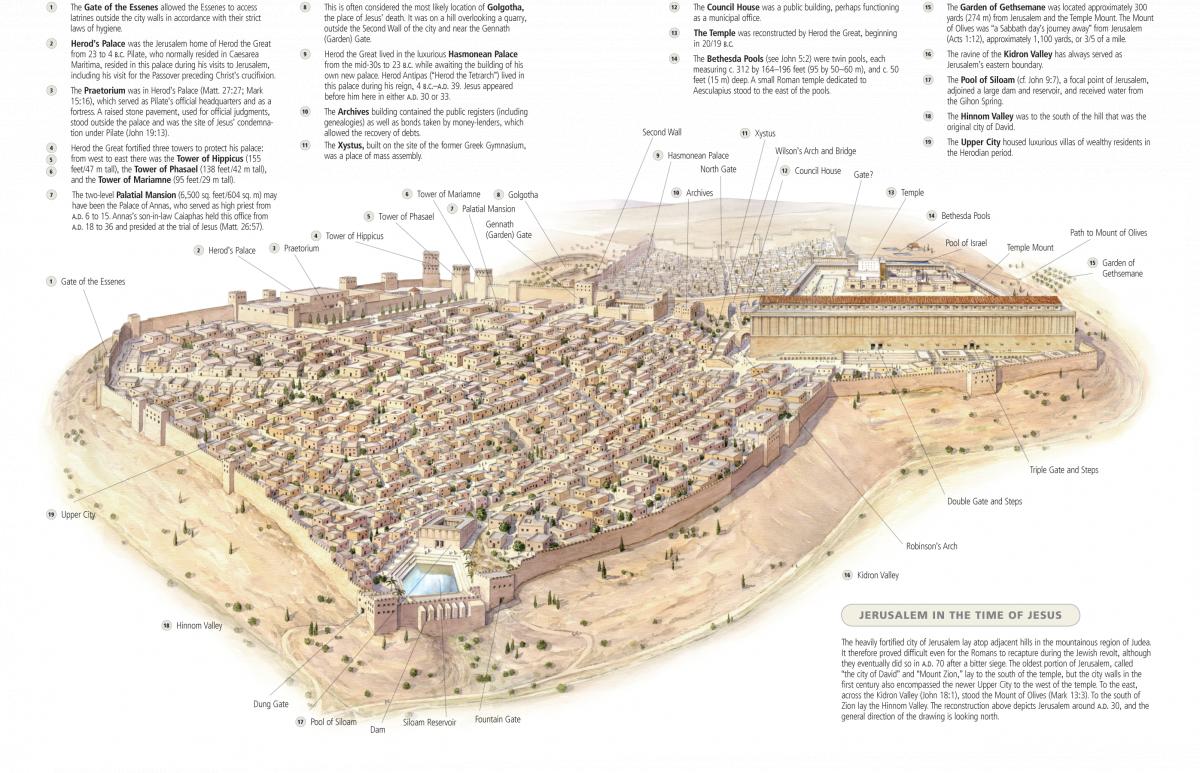
This section of five verses in MARK seems rather straight-forward; yet, to glean what was written by the author and assist in moving ahead, it's helpful to have a visual lay of the land.

First, a link that depicts Jerusalem around 30 AD; the general direction of the drawing is north -- Jerusalem in the Time of Jesus. To the upper right of the drawing is the area from which Jesus and his disciples traveled -- "Path to Mount of Olives" and "Garden of Gethsemane" -- to get to the Temple.

Second, a link that depicts the Temple Mount. To the right is the eastern wall of Jerusalem -- again the direction from which Jesus and his disciples came.

Before entering the temple precincts, pilgrims would bathe themselves (a cleansing ritual) -- lower left on the drawing. Within this formidable structure, approximately 30 acres large [i], was the Temple Mount, which was separated by walls and gates -- a square within a square within a square.

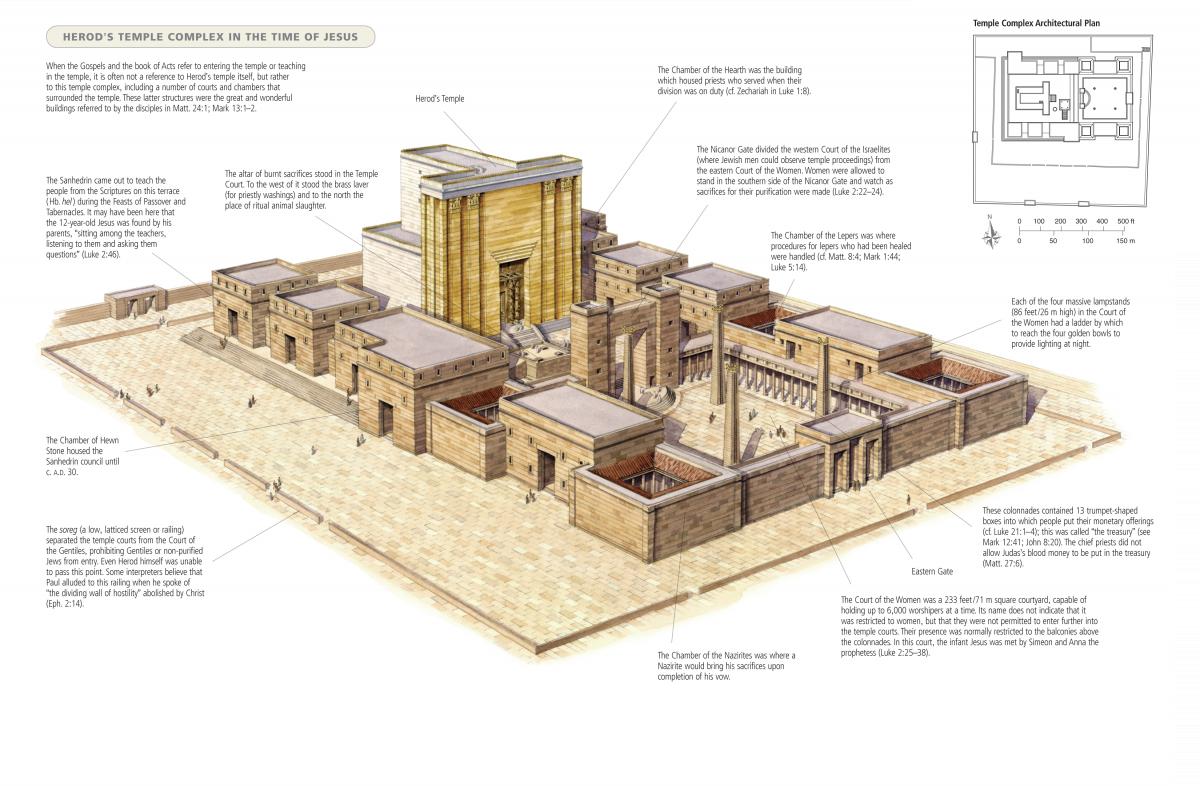
Third, a link that depicts the Temple Complex in the time of Jesus.

A soreg (a low, latticed railing about four feet high with large openings guarded by Levites [ii]) surrounded the temple complex, separating Gentiles and non-purified Jews from entering the temple courts and chambers. It was said if a Gentile passed this particular point, the Court of the Gentiles, the penalty was death. [iii]

Throughout the complex, various chambers and courts were designated. Women may enter past the Court of the Gentiles; however, unless they had a sacrifice to offer, they may not proceed further than the Court of the Women. In the Court of the Israelities, offerings were handed by the worshippers to the priests. [iv] The inner court was the Court of the Priests. Within the Court of the Priests was the Temple.

The approximate size of the temple complex would be the length and width of two football fields. The whole area, with all of the different Courts, was the sacred precincts (hieron). [v]

Fourth, a link that depicts Herod's Temple (otherwise known as the Second Temple which replaced the First Temple destroyed when the Jewish nation was exiled to Babylon). The Temple (later destroyed in 70 AD) was located on the site now known as the Dome of the Rock.

Let's next focus on…

Money changing hands -- "…selling and those who were buying in the temple." To get a clearer picture, what exactly was being exchanged and at what cost to the individual buying?

Did You Know…?
Only one coin was accepted as proper payment for the Jewish Temple tax -- the Tyrian shekel. Every Israelite male over 20 years old was required to make an annual payment of a half-shekel (Exodus 30:13-16, 38:26). In everyday business, the Jews used Roman coins which contained 80% silver. The religious authorities demanded only Tyrian shekels (95% purity) be used to pay the Temple tax. [vi]

To put this into perspective, consider a half-shekel as a sum of 6p. "This was the equivalent to one or two days' wages for an average worker." [vii]

Adding to this, using instructions provided in Exodus chapter 12, the Jews were to choose a lamb for the Passover sacrifice. Only an unblemished lamb would suffice, and it would be thoroughly checked. But what if you couldn't afford a lamb? Leviticus 5:7 allowed the poor to offer two doves as a substitute sacrifice.

Outside, doves could be bought cheaply for 3.5p a pair, but they also had to be without blemish. You can imagine the "gain" game with the temple inspectors. Because inside, the cost for a pair of doves would be as high as 75p. [viii] At that price, the low end to afford this would be 12 days worth of wages.

Plus… there was a fee for the exchange service "as high as 10 or 12 percent." [ix] Should the coin brought for exchange exceed the tax of a half-shekel, there would be another fee before the person could actually get their change. [x] Talk about a crooked shell game. As Leah * stated, "It was a shake-down!"

A half-shekel here, possibly 12 half-shekels there, a few more half-shekels for this and that,… Throw in the time it took travelers to get to the Temple and back home, plus the number of days in Jerusalem. It all adds up to a lot of lost wages.

It didn't stop there with the coins. "The sellers either belonged to the High-Priestly hierarchy or paid a large fee to temple authorities for the privilege of selling. Whichever was the case, the High-Priest's family benefited monetarily." [xi]

Who wasn't benefiting from this mind-boggling, sleight-of-hand scenario? Those honestly wanting to honor God.

In verse 15, Jesus entered the temple area which would've been the Court of the Gentiles. It was the largest section of the Temple complex and open to anyone -- not just Gentiles. With the inner Temple precincts being relatively small, most Jewish worshipers probably ended up in this outer court. While Gentiles couldn't go past this area, those Jews who were ritually pure could proceed across the balustrade to the next level. [xii]

This outer court was meant for prayer and preparation however it had to have been utter chaos with pilgrims, merchants, money changers, authorities, animals filling this space. With thousands of people in Jerusalem for Passover, with thousands of animals being brought and bought in the court, visualize the loud, crazed trading floor atmosphere of the Wall Street Stock Exchange mixed together with a cramped, smelly Livestock Auction. How could one quietly reflect or even think clearly enough to formulate a prayer?

And the court was also being used as a shortcut by people carrying pots, pans and various containers, which was actually considered a sacrilege by the Rabbis. [xiii] This refers to verse 16.

Where was the reverence for God?!? No wonder Jesus was angry! 

In verse 17, Jesus makes mention of Isaiah 56:7. "For all nations" are gathered together in this part of the temple, but worshipful prayer has been replaced by greed and those openly robbing the poor.

Jesus was defiantly challenging the sacrificial system. Jesus was defiantly challenging the religious system so that "all nations" have direct access to God. He was taking head-on the scribes and the chief priests.

The people were astonished and mesmerized, spellbound and in awe. A revolution was taking place, and fear had struck the hearts of the authorities who stood to lose everything.

This Jesus had to be stopped!

NEXT
On whose authority?; facing the truth


[i] The Gospel of Mark, Barclay -- p. 272
[ii] Daily Minyan, "Court of the Gentiles in the Jewish Temple," Gene Schlomovich
[iii] The Gospel of Mark, Barclay -- p. 272
[iv] The Gospel of Mark, Barclay -- p. 273
[v] The Gospel of Mark, Barclay -- p. 273
[vi] The Role of Coins in the First Revolt -- USC
[vii] Jewish New Testament Commentary -- p. 56
[viii] The Gospel of Mark, Barclay -- pp. 273-274
[ix] MacArthur Study Bible -- p. 1486
[x] The Gospel of Mark, Barclay -- p. 273
[xi] MacArthur Study Bible -- p. 1485
[xii] Daily Minyan, "Court of the Gentiles in the Jewish Temple," Gene Schlomovich
[xiii] The Renaissance New Testament -- p. 305

* Member of the Study Group